
Water utilities are facing mounting pressures from ageing infrastructure, climate volatility, growing industrial demand, and increasingly stringent regulatory requirements. This joint white paper by UtiliOS and Cumulocity explores how Monitoring-as-a-Service (MaaS) enables utilities to modernise operations with fully managed IoT infrastructure, real-time monitoring, and actionable intelligence—helping reduce water loss, improve operational resilience, and unlock the full value of smart water infrastructure.
Published August 6, 2026
Monitoring-as-a-Service
Unlocking the Full Value of Smart Water Infrastructure
Water utilities face an increasingly complex operational landscape. Beyond managing supply and demand as well as massive, capital-intensive distribution networks and pipelines, a multitude of new challenges have emerged that they now also have to balance:
- Aging Infrastructure: A significant portion of core water and wastewater assets is reaching the end of its operational lifespan simultaneously, requiring massive capital reinvestment.
- Climate Volatility: Shifting weather patterns and long-term drying trends mean utilities can no longer rely on historical baselines to predict supply and manage quality.
- New Industrial Demand: The rapid growth of high-water-use facilities—specifically AI data centers and green hydrogen projects—is placing unexpected, heavy demands on urban water capacity.
- Stricter Regulation: Enhanced legislative frameworks, such as the Security of Critical Infrastructure (SOCI) Act, mandate unprecedented levels of network security, auditability, and reporting compliance.
To manage these compounding pressures without overextending capital budgets, utilities must modernize how they monitor and maintain their networks.
Overcoming the Complexity Barrier
Real-time monitoring of assets and infrastructure and fusing it with additional data like geo-information or weather data to better contextualize it allows utilities to address each of these challenges:
- Preventing Infrastructure Failures: Acoustic and pressure sensors identify micro-leaks early, allowing teams to perform targeted repairs before small faults escalate into costly pipeline breaks.
- Stabilizing Supply and Quality: Continuous tracking of catchment levels and chemical parameters allows operators to adjust treatment processes instantly during sudden weather shifts.
- Managing Heavy Industrial Loads: High-frequency meters monitor real-time usage at data centers and energy plants, enabling the utility to balance pump schedules and protect residential water pressure.
- Simplifying Regulatory Audits: Automated data collection removes manual reporting errors, providing water authorities with the exact, time-stamped digital logs required for critical infrastructure compliance.
This, however, introduces a new set of challenges. It not only necessitates the deployment of different sensors to the field including for example vibration sensors to enable predictive maintenance for pump stations or acoustic/pressure sensors to monitor pipeline networks. Ensuring that all data is being made available in one single system to create a single source of truth instead of maintaining multiple completely siloed systems is key to unlocking the full potential.
Building and maintaining such monitoring networks also comes at a cost. Purchasing hardware, network gateways, and software licenses requires significant upfront capital expenditure. Furthermore, the hidden, long-term operational costs—such as sensor calibration, battery replacements, and field maintenance—are frequently underestimated. In addition to that, implementing a modern digital water network requires specialized expertise in data engineering, software architecture, and cybersecurity.
Especially for smaller utilities, the risk of a failed, expensive, or overly complex technology deployment often outweighs the perceived benefits. As a result, many choose to remain with reactive, manual asset management simply because it feels more predictable than navigating a complex digital transformation alone.
The Path Forward: Turnkey Water Operations
Monitoring as a Service (MaaS) fundamentally changes how water utilities approach digital transformation. Instead of forcing utilities to become technology companies that buy, build, and maintain their own infrastructure, MaaS turns real-time monitoring into a turnkey utility.
By delivering hardware, connectivity, and data analytics under a single, fully managed subscription model, MaaS directly neutralizes the operational bottlenecks that traditionally stall smaller and regional providers.
- Eliminating Upfront Capital Expenditures (OPEX vs. CAPEX): MaaS completely removes the financial risk of technology adoption by absorbing the upfront costs. Utilities pay a predictable monthly fee which not only covers the purchase of expensive hardware but also operational costs.
- Instant Access to Expertise: With MaaS, utilities do not need to scale up internal IT, data engineering, or cybersecurity teams to leverage advanced AIoT. Smaller utility crews can keep their boots on the ground doing what they do best—managing water—while AIoT and security specialists of the service provider take care of deploying and operating the advanced monitoring and predictive maintenance solutions as well as the underlying (communication) infrastructure.
- A Unified Source of Truth: Modern MaaS platforms leverage cloud-native architectures and open APIs to pull data from entirely different sensor types (vibration, acoustic, flow). It refines and fuses this infrastructure data with context like weather and GIS mapping, delivering a single, integrated stream straight into dashboards, GIS maps, or billing software. As communication and security standards evolve, the service provider handles upgrades behind the scenes, ensuring the utility’s monitoring capability never becomes outdated.
- Actionable Intelligence: Uses built-in machine learning and streaming analytics capabilities to filter out background noise, delivering clear, prescriptive notifications so field crews can focus on fixing leaks rather than chasing false alarms or being overwhelmed with thousands of raw daily pressure alerts.
Monitoring-as-a-Service eliminates the choice between technical stagnation and financial risk. By converting complex infrastructure into a fully managed, turnkey subscription, MaaS delivers the full power of real-time asset monitoring and data fusion without the operational headaches.
Future-Proofing Smart Water Infrastructure
About Cumulocity & UtiliOS
Successfully deploying Monitoring-as-a-Service requires two distinct technological capabilities: a highly scalable, secure and extensible platform providing the foundation to reliably connect up to millions of devices, systems and 3rd party applications and a specialized domain expert that deeply understands water network dynamics.
Built on Cumulocity’s enterprise-grade AIoT platform, UtiliOS combines a secure, scalable horizontal technology foundation with specialised smart water intelligence. This combination allows utilities to benefit from proven industrial platform capabilities while deploying applications designed specifically for water network operations.
Cumulocity: The Enterprise Foundation
Cumulocity provides the enterprise-grade foundation that underpins the MaaS solution. By managing secure connectivity, device lifecycle management, integration and operational resilience, it removes much of the complexity traditionally associated with large-scale AIoT deployments, allowing utilities to focus on operational improvement rather than platform management.
- Hardware-Agnostic Integration: Water networks rely on varied hardware—from acoustic loggers and pressure sensors to diverse digital meters. Cumulocity effortlessly connects any device or gateway across LPWAN or cellular networks, ensuring the utility is never locked into a single hardware vendor.
- Cybersecurity by Design: Critical infrastructure demands security as a core platform capability rather than an afterthought. Cumulocity provides enterprise-grade security, device lifecycle management, access controls and comprehensive auditability that help utilities simplify compliance with evolving regulatory frameworks while reducing operational risk.
- Industrial Data Processing: Cumulocity continuously evaluates operational data as it is generated, filtering, enriching and contextualising information before it reaches downstream applications. This enables faster operational responses today while creating trusted industrial data ready for advanced analytics, AI and intelligent automation.
UtiliOS: The Smart Water Intelligence Layer
While Cumulocity provides the robust, enterprise-grade AIoT foundation for reliable data pipelines and device management, UtiliOS delivers the specialised intelligence layer that turns raw smart meter data into measurable water savings and operational excellence unlocking the full value of digital metering.
Built by water industry professionals, UtiliOS goes far beyond basic monitoring. It is purpose-engineered to solve the biggest challenge in smart metering: closing the gap between insight and action.
Key Differentiators for Utilities and Commercial Users:
- Advanced Leak Intelligence & Addressable Baseflow (ABF) Analysis: UtiliOS continuously tracks consumption patterns, isolating overnight and non-peak usage to detect hidden leaks and developing anomalies long before they become costly failures – delivering early warning and assisting with root cause analysis.
- District Metered Area (DMA) Optimisation: Real-time water balancing across digital network zones enables utilities to instantly identify and quantify areas with increasing non-revenue water losses, dramatically improving network efficiency and regulatory compliance.
- AWARE – Active Water Analysis Risk & Efficiency Service: This is UtiliOS’ unique closed-loop capability. It doesn’t just flag issues. It drives investigation, corrective action, verification, and sustained savings. Every alert is tracked through to resolution and reported with clear, auditable outcomes.
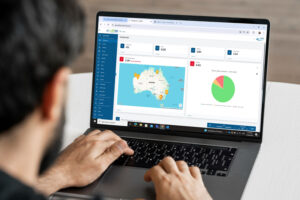
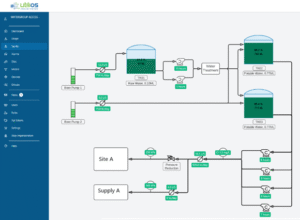
- Actionable, User-Centric Intelligence: Intuitive dashboards, GPS-mapped network views, prioritised workflows, and seamless integration with billing and asset systems mean operational teams get decision-ready insights instead of raw data overload. Emerging AI features, including natural language querying (“Show me abnormal usage at Site xyz this week”), predictive maintenance, and intelligent recommendations, make the platform remarkably intuitive for both technical and non-technical users.
The results speak for themselves. In partnership with Cumulocity, UtiliOS has helped customers including Sydney Water and Woolworths achieve over 2.3 billion litres of verified water savings and $7.7 million in cost reductions. For water utilities and commercial operators, UtiliOS and Cumulocity deliver the perfect solution for MaaS: Reliable smart metering infrastructure combined with deep domain intelligence that doesn’t just monitor water. It actively saves it, reduces risk, strengthens ESG performance, and generates rapid, bankable ROI.
Outlook: Building the Resilient Network of Tomorrow
Looking ahead, the digitization of water infrastructure will evolve from a competitive advantage to a baseline regulatory and operational necessity. As water scarcity intensifies and urban industrial footprints expand, the utilities that thrive will be those that have decoupled their operational capabilities from their internal IT constraints.
The Predictive Utility: The next frontier of smart water management lies in widespread automated optimization. By leveraging the data streams, utilities will increasingly move past simple leak detection and into automated pressure management, localized water-quality forecasting, and dynamic, algorithmic grid adjustments.
Furthermore, as communication technologies shift and new cyber threats emerge, the MaaS model ensures that a utility’s digital defenses and software capabilities update seamlessly in the background. Partnering with a managed ecosystem ensures that water providers remain permanently modern, compliant, and resilient—no matter what pressures the future brings to the tap.
Read and download the original newsletter here: Monitoring-as-a-Service. Unlocking the Full Value of Smart Water Infrastructure | Cumulocity